




ORGANS OF PARIS © 2026 Vincent Hildebrandt HOME ALL ORGANS



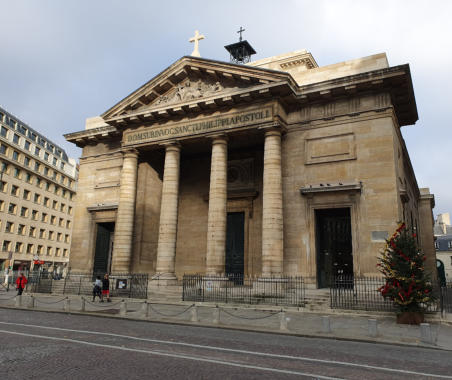
Saint-Philippe-du-Roule was built between 1774 and
1784 on the site of a former chapel. The present
building was designed by Jean-François Chalgrin in the
style of the early Roman basilicas. Its architecture later
became a model for many other Parisian churches,
such as Saint-Pierre-du-Gros-Caillou, Notre-Dame-de-
Lorette, Saint-Denis-du-Saint-Sacrement, and Notre-
Dame-de-Bonne-Nouvelle.
The church was later enlarged with an ambulatory and
several chapels designed by Hippolyte Godde
(1843–1847) and Baltard (1853). Its splendid axial
chapel, known as the Virgin’s Chapel, richly adorned
with paintings and gilding, could easily hold its own
alongside the Palace of Versailles or the Louvre.
The stained-glass windows on the lower level, in shades
of blue, were created by Émile Hirsch (1832–1904),
while those in the vaults are by Albert Maignan.
Between 2019 and 2021, extensive restoration work
was carried out on the roofs, timber structures, vaults,
and coffered ceilings.

C3
Barely completed in 1784, the church did not yet have a
large organ at the time of the Revolution. When the
Jacobins’ church on Rue Saint-Honoré was closed down, the
departmental administration transferred its organ to Saint-
Philippe-du-Roule.
The transfer was carried out by the builder Somer, but the
work progressed slowly due to delays in finishing the
gallery, and the instrument was not ready for use until
1799.
After the Concordat, the organ was overhauled in 1809 by
Pierre-François Dallery. It was first enlarged in 1834 by John
Abbey, then completely rebuilt by Merklin in 1861.
1903
Charles Mutin installed a completely new organ with 37
stops, though he kept the Positif case, which became purely
decorative.
1922
The instrument was cleaned, revoiced, and modified by
Abbey father and son, under the supervision of Henri Mulet,
then titular organist, who successfully applied his theory of
rational Stoplist of full choruses. Additions included a 32’
Bourdon in the Pedal (these works were left unfinished and
the stop is not playable at the console), a VI-rank Plein Jeu
on the Grand Orgue, and a IV–V-rank Plein Jeu on the Récit.
1938
Overhaul by Jean Perroux and Jules Isambart.
1945–1948
The organ was cleaned and overhauled by Jacques Picaud. A
general dusting took place, and on that occasion, the Plein
Jeu of the Grand Orgue was reduced from VI ranks to IV
ranks.
1990–1991
The instrument was completely rebuilt by the Maison
Renaud, with a Dulciana and Piccolo added to the Positif.
2009
Further work was carried out by Fossaert/Pellerin & Uys.
2019–2021
During restoration works in the church, Jean-Baptiste
Gaupillat undertook maintenance of the organ:
•
General cleaning of the instrument
•
Minor repairs
•
Activation of the 32’ Bourdon in the Pedal, installed at an
unknown date and previously incomplete
•
Overall tuning of the instrument
These heavy-duty works were carried out in collaboration
with SAS Laurent Plet.


1903 - Mutin (3)
1922 - Abbey (3a)
1938 - Jean Perroux & Jules Isambart (6)
1948 - Picaud (6)
1991 - Renaud (3a)
2009 - Fossaert / Pellerin & Uys (6)
2021 - Jean-Baptiste Gaupillat & Laurent Plet (5)
III/40 - traction I-II-Péd. : mécanique et Machine Barker
GO; III électrique
Stoplist
Titular organist
Valérie Aujard-Catot
Organiste célèbre ayant illustré l’instrument :
Henri Mulet, Michel Boulnois
Parish website
Videos
2019-2022: Travaux de dépose et de repose partielle du
Grand Orgue de tribune dans le cadre de travaux de
restauration des toitures.
Démontage et accord du grand orgue de l'église Saint-
Philippe du Roule








The organs of Paris


ORGANS OF PARIS © 2026 Vincent Hildebrandt
C3
Barely completed in 1784, the church did not yet have a large
organ at the time of the Revolution. When the Jacobins’
church on Rue Saint-Honoré was closed down, the
departmental administration transferred its organ to Saint-
Philippe-du-Roule.
The transfer was carried out by the builder Somer, but the
work progressed slowly due to delays in finishing the gallery,
and the instrument was not ready for use until 1799.
After the Concordat, the organ was overhauled in 1809 by
Pierre-François Dallery. It was first enlarged in 1834 by John
Abbey, then completely rebuilt by Merklin in 1861.
1903
Charles Mutin installed a completely new organ with 37
stops, though he kept the Positif case, which became purely
decorative.
1922
The instrument was cleaned, revoiced, and modified by
Abbey father and son, under the supervision of Henri Mulet,
then titular organist, who successfully applied his theory of
rational Stoplist of full choruses. Additions included a 32’
Bourdon in the Pedal (these works were left unfinished and
the stop is not playable at the console), a VI-rank Plein Jeu on
the Grand Orgue, and a IV–V-rank Plein Jeu on the Récit.
1938
Overhaul by Jean Perroux and Jules Isambart.
1945–1948
The organ was cleaned and overhauled by Jacques Picaud. A
general dusting took place, and on that occasion, the Plein
Jeu of the Grand Orgue was reduced from VI ranks to IV
ranks.
1990–1991
The instrument was completely rebuilt by the Maison
Renaud, with a Dulciana and Piccolo added to the Positif.
2009
Further work was carried out by Fossaert/Pellerin & Uys.
2019–2021
During restoration works in the church, Jean-Baptiste
Gaupillat undertook maintenance of the organ:
•
General cleaning of the instrument
•
Minor repairs
•
Activation of the 32’ Bourdon in the Pedal, installed at an
unknown date and previously incomplete
•
Overall tuning of the instrument
These heavy-duty works were carried out in collaboration
with SAS Laurent Plet.


1903 - Mutin (3)
1922 - Abbey (3a)
1938 - Jean Perroux & Jules Isambart (6)
1948 - Picaud (6)
1991 - Renaud (3a)
2009 - Fossaert / Pellerin & Uys (6)
2021 - Jean-Baptiste Gaupillat & Laurent Plet (5)
III/40 - traction I-II-Péd. : mécanique et Machine Barker
GO; III électrique
Stoplist
Titular organist
Valérie Aujard-Catot
Organiste célèbre ayant illustré l’instrument :
Henri Mulet, Michel Boulnois
Parish website
Videos
2019-2022: Travaux de dépose et de repose partielle du
Grand Orgue de tribune dans le cadre de travaux de
restauration des toitures.
Démontage et accord du grand orgue de l'église Saint-
Philippe du Roule

